
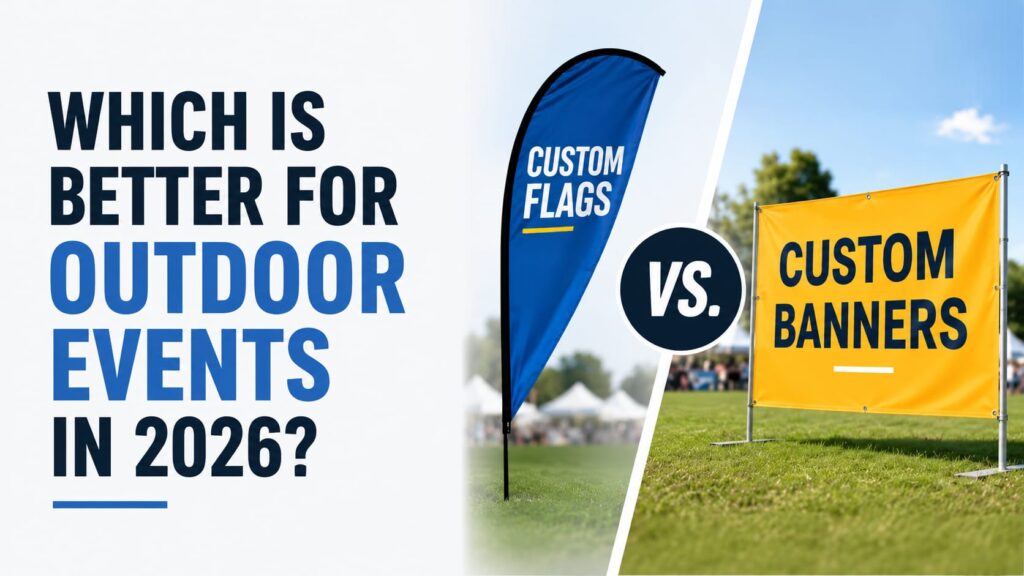
Last weekend, I watched a vendor at the farmers market pack up early because their setup kept falling over.
Third gust of wind, third time their banner frame tipped. They finally just gave up around 10:30 and went home. Meanwhile, the booth next door – four simple flags – stayed put the entire day. Made me think about how many people get this decision completely wrong.
Here’s What Nobody Actually Tells You
Flags and banners aren’t interchangeable. Not even close.
A banner is your message locked in place. Stretched tight, bolted down, showing the exact same thing whether someone’s two feet away or twenty. It’s a sign that happens to be fabric instead of metal.
Flags? They live and breathe. Wind hits them, they move. That movement pulls eyes even when people are actively trying to ignore you.
And that’s either going to save your event presence or kill it, depending on what you’re selling and where you’re set up.
Three years back, I helped a friend with their booth at a street festival. We printed these absolutely beautiful banners – her graphic designer went wild with detail, small fonts, this whole artistic vibe. Looked incredible when we laid them out on the conference room table.
Outside? Total disaster.
People walking past couldn’t read anything. They’d glance over while moving and just see… colors. Maybe catch two words if they were really trying. The whole intricate design we’d spent $400 on might as well have been blank from five feet away.
Guy next to us had one flag. Logo. Three words. That’s it.
His booth stayed busy all day. Ours didn’t. Learned that lesson the expensive way.
When You Actually Want Flags
Distance matters more than you think.
If you’re at one of those sprawling outdoor markets where everything’s spread across a football field and people are wandering around half-lost, height is everything. A 12-foot feather flag gets spotted from across the entire venue. Same message on a banner? You’d better hope they walk within spitting distance.
Parking lot events are where flags really earn their keep. People leave their cars, they’re scanning dozens of identical white tents, they’re trying to figure out where the hell anything is. Flags act like beacons. That movement catches peripheral vision in ways static displays simply can’t.
Beaches, waterfronts, anywhere near water – custom flags are basically the only option that makes sense. Because there’s always wind. Not sometimes wind. Always. Banners turn into sails, and I’ve personally watched too many banner frames get yanked out of the ground and go tumbling across the sand like deranged cartwheels.
Crowded festivals where you’re competing with 80 other vendors? Go vertical or go home. Flags claim airspace. Banners are stuck fighting for horizontal real estate that’s already jammed with tents, tables, people, and everyone else’s stuff.
But.
They’re terrible for anything complex. Got a detailed message? Forget it. Flags give you maybe five words of readable space. Try to cram more and you’ve created something nobody can actually parse while it’s flapping around.
And they wear out faster than people expect. We replaced our main event flag twice in one season (2024, never letting myself forget that expensive summer) because the stitching along the edges just gave up. Wind does that.
Why Banners Still Matter
Banners are the reliable workhorse option.
You actually get space to say something. A 3×8 foot banner gives you room for your logo, tagline, website, contact info, maybe a QR code people can scan without squinting. Try fitting all that on a flag and congrats, you’ve made an unreadable mess.
They’re adaptable too. Hang them on fences. String them between posts. Attach them to building walls. Drape them over your table. Flags need dedicated poles or bases – extra equipment you’ve got to haul around and set up.
Durability’s another thing. A decent vinyl banner will last you three to five years of regular outdoor use if you don’t treat it like garbage. That’s assuming you actually take it down between events instead of leaving it up 24/7 through hurricanes and blizzards, but for normal weekend events, they hold up.
One of my clients runs community gatherings year-round. Same banners since 2023. Still look professional. Still perfectly readable. Still doing exactly what they’re supposed to do.
Their flags from that same period? All replaced. Every single one.
Cost-wise, banners win per square foot. You can get a quality 3×6 banner for roughly the same price as a decent feather flag, but you’re getting three times the actual printable area. Math works out better.
What Really Happens When Weather Gets Nasty
Light wind — say, 5 to 10 mph? Everything’s fine. Flags look great with that gentle ripple. Banners stay readable.
Moderate wind around 10-20 mph? Flags still perform if you’ve got proper bases. Not those pathetic little sandbags some people try to use. Real bases. Banners start showing stress. You’ll hear them snapping at the grommets if they’re not secured at all four corners. That sound gets old fast.
Strong wind above 20 mph? This is where outdoor event signage setups completely fall apart.
Flags need serious weight underneath them. I’m talking 40 pounds minimum. Maybe 50 if it’s really blowing. Those 15-pound plastic bases people grab at the big box store? Might as well save your money and just let your flag blow away immediately. At least you’ll save time.
Banners stretched between tall posts become dangerous. I’ve watched them rip free and go sailing. Not fun when there’s a crowd around.
Rain’s weird because it affects both differently. Most banner materials are waterproof, but water weight makes them sag. They start looking droopy and unprofessional within about 20 minutes of steady rain. Flags actually handle it better since water just runs off instead of pooling.
Sun damage though – that’s the thing nobody thinks about until it’s too late. UV rays fade everything eventually, but flags get hit harder because they’re exposed on all sides. Banners you can hang in partial shade or rotate. Flags are just out there taking the full beating.
The Setup Reality (And Why It Matters)
Time is money when you’re setting up before an event opens.
Flags are fast. Slide pole sections together, attach flag, drop it in base. Done. Three minutes. Maybe four if you’re having a bad morning. I can set up four flags before I’ve even started messing with one banner.
But here’s the thing about flags – they need level ground. They tip on uneven surfaces. And tilted flags look unprofessional as hell. Like you didn’t care enough to do it right.
Banners are more forgiving. You’re usually attaching them to existing structures, so uneven ground doesn’t matter as much.
Storage and transport? Flags win by a mile. They pack down small. I can fit six flags in the same space as two rolled banners. When you’re doing multiple events and loading everything in and out of a vehicle every weekend, that space savings adds up fast.
What’s Actually Working Right Now
Smart vendors use both. Shocking revelation, I know.
But seriously – they’re not competing tools. They’re complementary.
Put flags at your perimeter for visibility. Put a banner across your booth front with your actual detailed message. Flags handle wayfinding and catching attention. Banners handle communication and branding.
There’s a wedding venue near me that does outdoor showcases every spring. They line their entrance path with six custom flags in their brand colors – creates this visual corridor you can’t possibly miss. Then they’ve got detailed banners at the actual booth explaining packages, pricing, all that stuff people need to know.
Works perfectly because each piece has a specific job to do.
Other trend I’m seeing that’s actually useful: QR codes on banners, simple logos on flags. Makes sense. People don’t scan moving targets. But they will pull out their phone for a clear, static QR code on outdoor advertising banners. Keep your flag design simple enough that someone remembers it when they get to your booth.
Just Pick One Already
If you can only afford one (budget’s tight, space is limited, whatever):
Choose flags if you’re competing for attention in a crowded space, you need visibility from far away, you’re dealing with unpredictable weather, or portability matters more than anything else.
Choose banners if you need to communicate actual details, you have structures to attach them to, you want maximum longevity, or your events typically have calmer conditions.
Honestly though? If you’re serious about doing outdoor events – more than three or four times a year – just budget for both. Basic setup of two flags and two banners runs maybe $300-500 total for decent quality. Not cheap. But also not insane when you consider they’ll last years and make your booth look like you actually know what you’re doing.
The Expensive Mistakes Everyone Makes
Buying cheap. That’s the big one.
I get it. Money’s tight. But those $30 flags from the discount store? They’ll survive exactly one windy event before the fabric shreds or the pole snaps in half. Same with those bargain-basement banners printed on material so thin you can practically see through it.
Spend real money for proper materials. Flags should be 4-ounce polyester at minimum. Banners should be 13-ounce vinyl. Costs more upfront. But replacing garbage equipment twice a year gets expensive way faster, plus the hassle of dealing with failures during events.
Second mistake is ignoring what actually shows up outdoors. Dark colors look sophisticated in photos. They disappear from a distance outside. Bright, high-contrast colors grab attention. Your Instagram aesthetic and your outdoor visibility strategy are probably different things, and you need to pick which one matters more.
(Hint: if people can’t see you, your aesthetic doesn’t matter.)
Make It Work Or Don’t Bother
Whatever you choose, secure it properly.
Flags need weight. Real weight. Those cheap plastic bases people fill with water? Fine for a dead-calm indoor expo. Outdoors with any actual wind, they’re a lawsuit waiting to happen when your flag pole turns into a projectile and takes someone out.
Banners need tension at all four corners. Loose corners flap, rip, look sloppy. Use bungee cords instead of rope when possible – they absorb shock better when wind gusts hit.
And bring backups. Always.
Murphy’s Law applies to outdoor events harder than anywhere else. I pack one extra flag and one extra banner beyond what I think I’ll need. Used them way more often than I expected to.
So Which Is Better?
Wrong question.
It’s not “which is better.” It’s understanding what each tool actually does well, matching that to your specific situation, and – ideally – using both strategically.
I’ve seen people absolutely dominate with just flags. I’ve seen others crush it with only banners. But the vendors who really stand out? They’ve figured out how to use both for what they’re actually good at instead of trying to make one do everything.
That’s the real answer.